Ask ten cat owners why do cats purr and most will say the same thing: the cat is happy. That is often true, but it is only part of the story. Purring is one of the strangest and least understood sounds in the animal world, produced by house cats and some big cats alike, and it means more than simple contentment. Cats purr when they are calm, but also when they are frightened, hungry, or hurt. Understanding the difference tells you a lot about the animal curled up on your lap.
How a purr is actually made
For a long time nobody was sure where the sound came from, since cats have no obvious organ built for it. The leading explanation is that the brain sends rapid signals to the muscles of the voice box, which open and close the space between the vocal cords roughly twenty five to one hundred and fifty times a second. Air passing through on both the in breath and the out breath creates that continuous rumble, which is why a purr can run on almost without a pause. It is a neat trick, and one that few other animals can copy.
Contentment, but not only contentment
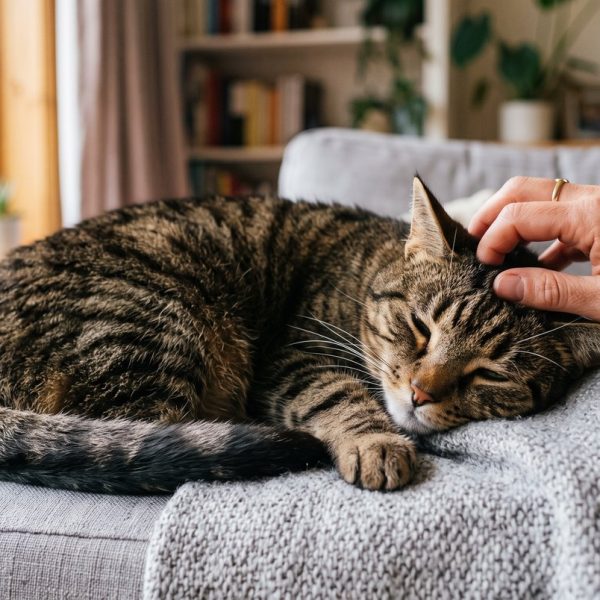
Most of the time, a relaxed cat purring on your knee really is a happy cat. Kittens purr within days of birth, partly to tell their mother where they are and that all is well while feeding. That early link between purring and safety seems to carry into adult life. This is the version everyone knows, and it explains why do cats purr when you pet them: your hand signals safety, and the cat answers in the only way it can.
The cry hidden inside the rumble
Here is the part that surprises people. Cats also purr when something is wrong. A frightened cat at the vet, a cat in pain, or a cat near the end of its life may all purr steadily. Researchers think purring can be self soothing, a way to calm the body under stress. Some studies have found that certain purrs contain a higher pitched cry, close in frequency to a human baby's, folded into the low rumble. That solicitation purr is hard to ignore, which is exactly the point when a cat wants feeding. So if a cat is purring but also hiding, off its food, or clearly unwell, the purr is a reason to call a vet, not a sign that all is fine.
Can purring actually heal?
One popular idea is that the frequencies in a cat's purr, roughly in the range of twenty five to one hundred and forty hertz, may help tissue and bone recover. The evidence in cats themselves is thin and mostly indirect, drawn from research on how similar vibrations affect healing in other settings. It is an appealing theory and it may hold some truth, but it is not settled science. What is clear is that purring costs the cat very little energy, which may be why it can keep going even when the animal is weak or injured.
Reading your own cat
The best guide is context. A purr paired with a loose body, slow blinks, and a raised tail is a content cat. A purr paired with flattened ears, wide eyes, or a tense crouch is a cat asking for space or help. Learning these signals is a bit like training a new puppy: you are learning the animal's language rather than forcing it into yours. Cats communicate constantly through sound and posture, much the way people lean on their own native language to say what they really mean. Pay attention and the vocabulary becomes obvious.
Purring turns out to serve several functions at once, which is a good reminder that simple-looking biology is usually doing more than one job. Skin behaves the same way, and routines that produce natural glowing skin generally work by supporting several processes gently rather than forcing one aggressively. Restraint is an underrated active ingredient.
Animal behaviour research is a reminder that a familiar thing can have several explanations at once, none of them complete. People prefer single causes. Arguments about why the cavs are performing well or badly follow the same pattern, with each analyst holding a favoured single factor.
What the science still cannot explain
Even now, purring keeps some secrets. As the encyclopedia entry on the purr notes, researchers still debate the exact mechanism and its full range of purposes. Cat owners, of course, run their own informal studies every day. Communities like the popular online gathering of cat owners are full of people comparing purr styles, from the quiet motorboat to the loud rumble that shakes a whole sofa. The science may lag behind, but the affection does not.
Do all cats purr?
Not every cat in the family tree can purr, and not every big cat can roar. As a rough rule, the smaller cats that purr, including your house cat, cheetahs, and bobcats, cannot roar, while lions and tigers roar but do not purr in the same continuous way. The split comes down to a small difference in the anatomy of the throat and the bone that supports the voice box. So the pet dozing beside you belongs to the purring branch of the family, sharing that rumble with some surprisingly wild relatives.
The short answer
So, why do cats purr? Because it works. It soothes them, it draws you closer, it calls for food, and it may even help them mend. A purr is not a single message but a whole small language, tuned over thousands of years to reach the humans who share their homes. The next time a cat settles on your lap and starts that low rumble, you will know it is saying far more than a simple thank you.
Most Read





Featured Posts